
[ad_1]
Mumbai: From decentralised screening at the ward level to subsidised robotic surgeries and new financial models, stakeholders across public health, tertiary care, insurance and patient advocacy called for a systemic overhaul to ensure that cancer innovation translates into equitable access.
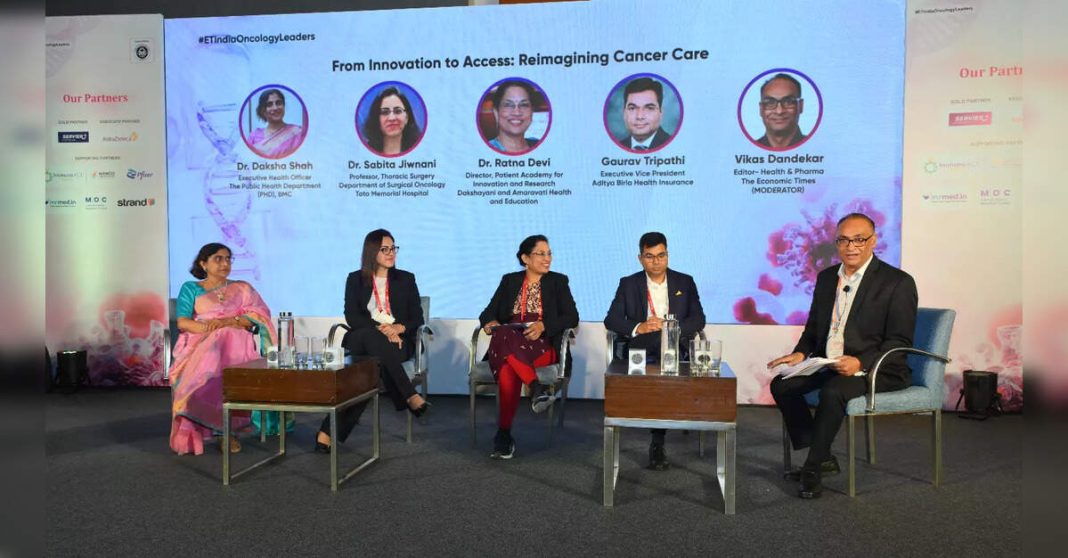
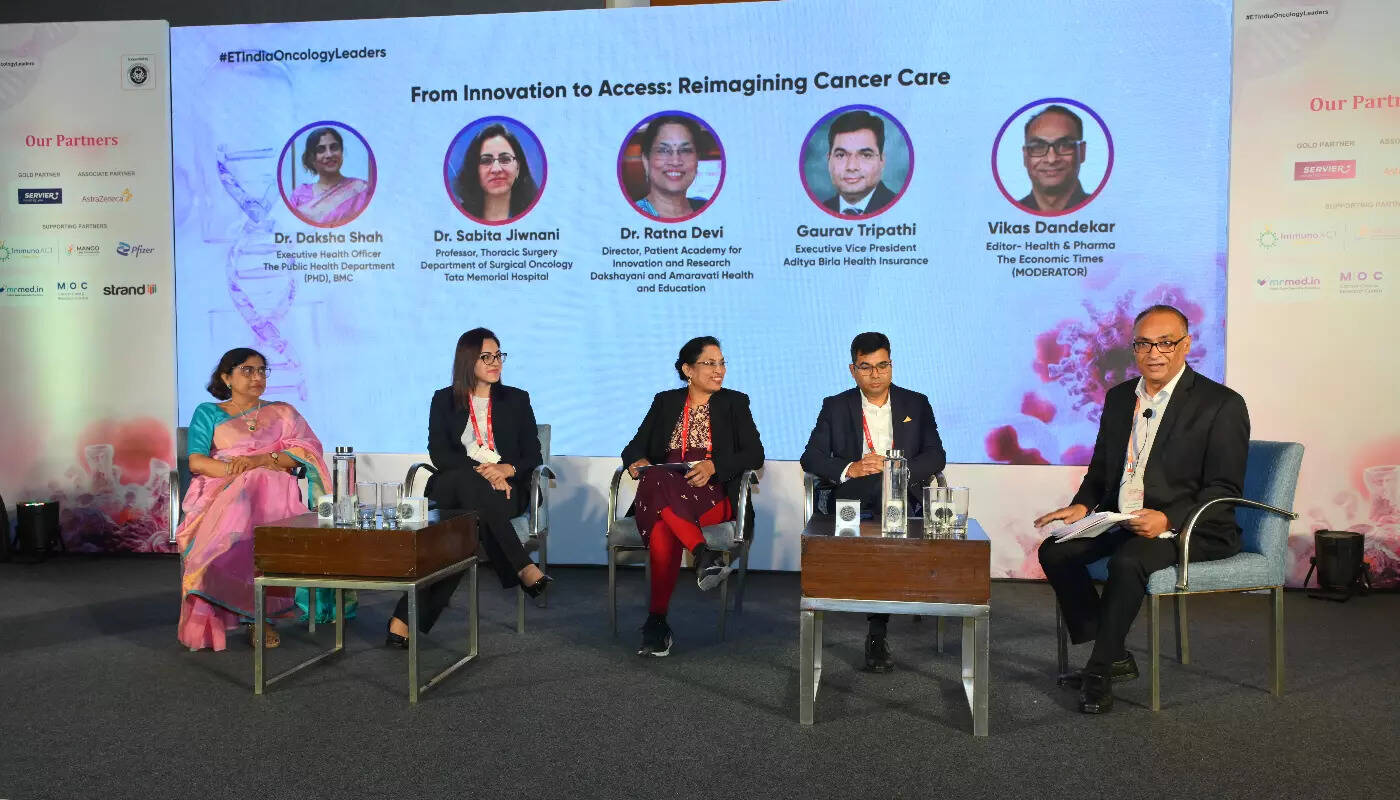
At the ETHealthWorld Oncology Leadership Summit, a panel discussion titled “Innovation to Access: Reimagining Cancer Care” brought together policymakers, clinicians, insurers and patient advocates to deliberate on closing India’s widening cancer care gap.
The panel featured Dr. Daksha Shah, Executive Health Officer, Public Health Department (PHD), BMC; Dr. Sabita Jiwani, Professor of Thoracic Surgery, Department of Surgical Oncology, Tata Memorial Hospital and Dr. Ratna Devi, Director, Patient Academy for Innovation and Research. The session was moderated by Vikas Dandekar, Editor – Health & Pharma, The Economic Times.
Primary Healthcare as the Gateway to Access
Setting the tone, Dr Daksha Shah underscored the importance of strengthening primary healthcare as the foundation for equitable cancer care.
Highlighting BMC’s Comprehensive Cancer Care Model rolled out a year ago, she said the civic body has integrated cancer screening into its network of over 200 primary health centres and “dhawa khanas” operating across Mumbai. The decentralised, ward-level approach focuses on symptom screening, risk assessment and basic investigations at the primary level, with structured referral pathways to secondary and tertiary facilities.
With technical support from Tata Memorial Hospital, BMC is building capacity among its staff to identify early cancers. Frontline ASHA workers are being trained to mobilise high-risk individuals, assist with Ayushman Bharat and ABHA ID registrations, and facilitate linkages to care.
However, Shah cautioned that large-scale screening must be matched by preparedness at higher levels of care.
“If lakhs of suspected cases emerge from screening programmes, our secondary and tertiary centres must be ready to absorb that load,” she noted, calling for simultaneous strengthening of referral hospitals.
She also pointed to public-private partnerships (PPP) as a mechanism to expand access. Under such arrangements, select hospitals offer concessional care to patients referred from BMC facilities, thereby reducing out-of-pocket expenditure for economically vulnerable groups.
Subsidised Advanced Care at Scale
From the tertiary care perspective, Dr Sabita Jiwani described the enormous patient burden at Tata Memorial Hospital, which sees approximately 75,000 patients annually but is able to treat only 25,000–30,000 due to capacity constraints.
With a long-standing mandate to serve economically disadvantaged patients, the hospital operates on a 60:40 model—where 60 per cent of treatment is highly subsidised.
Even high-end procedures such as robotic lung surgery, which may cost upwards of ₹10 lakh in private hospitals, are offered at under ₹75,000 for patients below the poverty line at Tata. Paid-category patients are also charged significantly less than private-sector rates.
Jiwani emphasised that innovation—whether minimally invasive surgery or robotic platforms—must not remain confined to elite centres. Tata Memorial was among the early adopters of robotic surgery in 2014 and continues to maximise utilisation despite limited infrastructure.
Beyond service delivery, she highlighted capacity building as critical to expanding access. The institution trains a large number of surgical oncology residents and also runs short-term courses for practicing surgeons to disseminate advances such as minimally invasive techniques.
“Despite training hundreds of specialists, it is still not enough for a population of 1.4 billion,” she observed.
The Missing Piece: Psychosocial and Nutritional Support
Bringing the patient voice to the forefront, Dr Ratna Devi stressed that the trauma of a cancer diagnosis extends far beyond medical treatment.
“The diagnosis itself is shattering,” she said, highlighting the psychological toll on both patients and caregivers. Mental health support, she noted, is often overlooked once patients step outside hospital walls.
Her organisation works to bridge gaps that lie outside the formal medical system—nutritional support, accommodation, documentation for financial aid, and navigation through complex bureaucratic processes.
Many families, particularly those travelling from distant states, struggle to access the 20–25 financial assistance schemes available at central and state levels due to lack of awareness and procedural hurdles. Her team helps patients obtain treatment estimates, complete paperwork, liaise with authorities and follow up on applications.
She also underlined the importance of nutritional support, especially for low-income families who lose wages during prolonged treatment. Without adequate nutrition, patients may not tolerate chemotherapy and may discontinue treatment prematurely.
Calling for systemic change, Ratna Devi advocated for institutionalising patient navigation, counselling, nutritional assistance and caregiver support within cancer care pathways. She also urged insurers to expand coverage to include home nursing and caregiver support, as seen in some Western models.
On prevention, she flagged environmental factors such as air and water pollution, microplastics and antimicrobial resistance as emerging threats that could undermine even the best surgical and chemotherapy outcomes.
A Call for Integrated Action
The panel concluded that bridging the innovation-access divide in cancer care will require coordinated action across the continuum—from primary-level screening and decentralised models, to tertiary capacity expansion, innovative financing, and comprehensive patient support systems.
As India grapples with rising cancer incidence and escalating treatment costs, the consensus was clear: technology and innovation must be embedded within a robust public health foundation, supported by multi-stakeholder collaboration, to truly make cancer care accessible and equitable.

[ad_2]
Source link