Runways are often made with human-made textures such as asphalt and concrete. However, natural surfaces such as gravel can be found at airports and airfields across the globe. As a result, airlines need the right tools in place to land on such runways. Let’s take a look at how they can achieve this.
Support from the manufacturer
Notably, in 1969, Boeing introduced a modification kit to help with gravel runway landings. The Unpaved Strip Kit was available for the 737-100 and 737-200 series aircraft. The equipment could be used on surfaces with no bumps that are raised more than three inches. Good drainage is also a requirement for the runway. Moreover, the surface material has to be at least six inches thick, and there can be no loose gravel.
The Boeing 737 Technical Site shares that the kit includes a nose-gear gravel deflector. This helps to keep gravel off the plane’s underbelly. There are also smaller deflectors on the oversized main gear. These prevent damage to the aircraft’s flaps.
The kit allows the use of protective metal shields over hydraulic tubing and speed brake cables. Moreover, glass fiber reinforces the underside of the inboard flaps.
Another key feature is that the kit provides abrasion-resistant Teflon based paint for the aircraft’s wing and fuselage undersurfaces. Vortex dissipators fitted to the engine nacelles, and screens in the wheel well also hold importance in the kit.

Special requirements
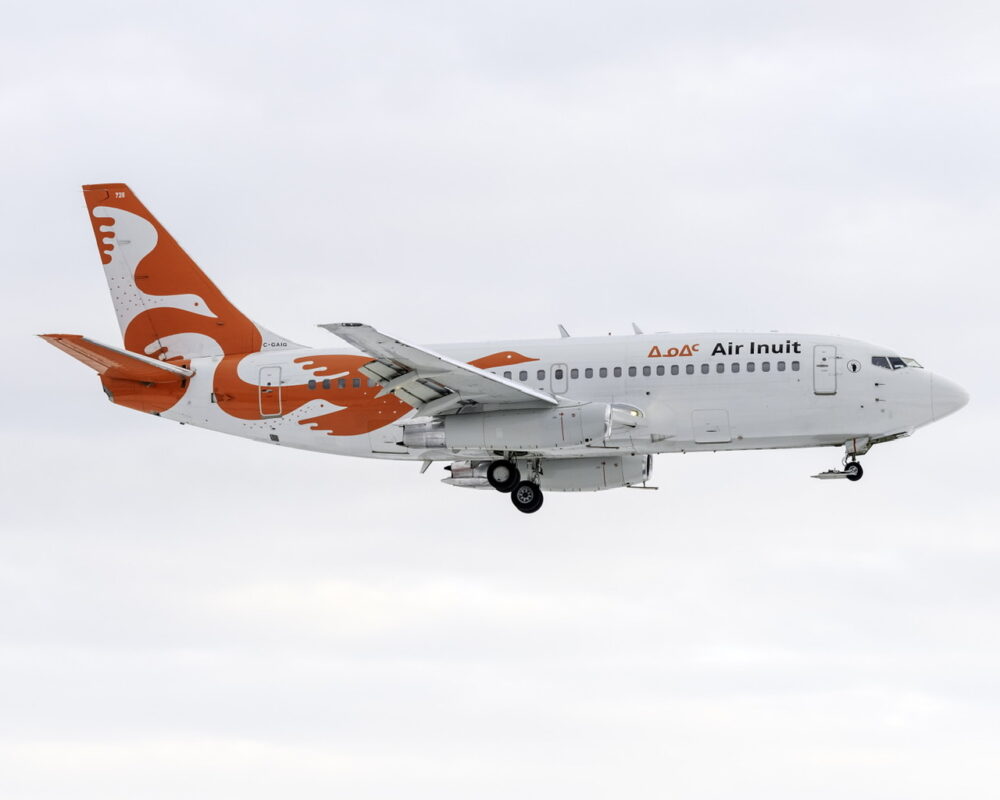
Carriers operating in the north polar region are more likely to consider their options when it comes to landing on gravel. In 2008, Air Inuit took on a Boeing 737-200 Combi with the ability to land on this surface. It was specifically adapted to handle services across the harsh conditions of the north.
Speaking of the 737, Alaska Airlines acquired its first new unit of the type when it began flying the 737-200 Combi in 1981. This plane went on to help the operator handle the challenging terrain of the areas it serves.
“Considered by many to be ideal for service within the state of Alaska, the unique aircraft – known as “Mud Hens” because they could be operated on muddy gravel runways – features a movable partition so it could be quickly reconfigured to carry a combination of cargo or passengers,” Alaska shared on its website.
“These aircraft became the workhorse of the fleet for intra-Alaska flying until 2007, when the last one was retired and donated to the Alaska Aviation Museum in Anchorage.”

Alaska isn’t a stranger to landing on gravel. In fact, on March 29th, 1967, the carrier’s Boeing 727-90C Golden Nugget landed on the gravel runway of Sitka’s Rocky Gutierrez Airport. Midwest notes that this landmark moment marked the city’s entrance into the jet age.
Care is needed
Altogether, airlines operating in harsh climates are well prepared to deal with the challenges that come with these operations. It is great to see that manufacturers also provide support to help these carriers adapt.
What are your thoughts about how some jet aircraft can land on gravel runways? Have you ever been on these services? Share your experiences on these flights with us in the comment section.
[ad_2]
Source link