[ad_1]
Southern Airways Flight 49 became one of aviation history’s most extraordinary hijackings, sending a DC-9 across multiple countries during a tense 30-hour saga.
Demonstrating its ruggedness, endurance, and reliability, the McDonnell-Douglas DC-9, one of the original short-range, low-capacity twinjets along with the Sud-Aviation SE.210 Caravelle and the British Aircraft Corporation BAC-111, was subjected to a more than 30-hour hijacking that took it from Canada to Cuba and numerous US cities in between.
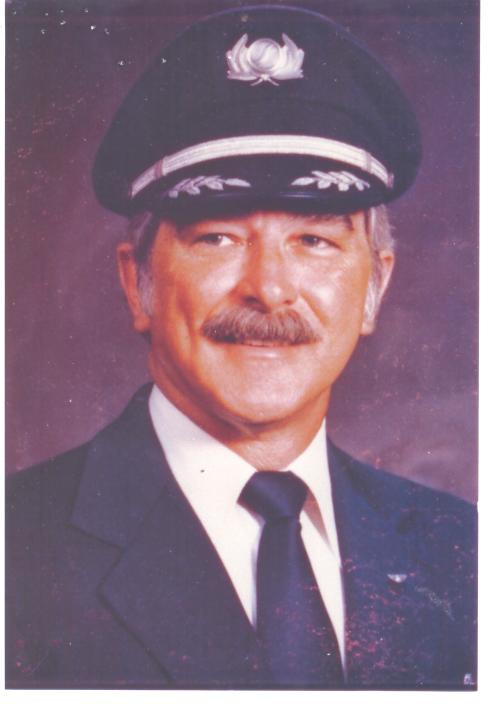
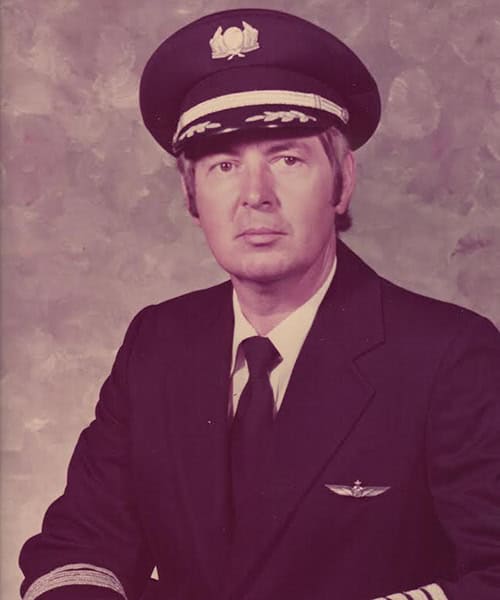
Piloted by Captain William R. Haas and First Officer Harold Johnson, the aircraft was commandeered on a multi-sector flight from Memphis to Miami with intermediate stops in Birmingham, Montgomery, and Orlando on 10 November 1972.
Accommodating 75 passengers, who were attended to by two cabin personnel—Karen Ellis and Dionna Holman—aircraft 904, operating as Flight 49, departed Memphis International Airport (MEM) at 1810 local time and routinely made the short hop to Birmingham (BHM), where it landed at 1850, disgorging 45 passengers, before redeparting for the 15-minute sector to Montgomery (MGM). It would never arrive.
As it began its descent from 10,000 feet, a black man rose from his seat and forced his way into the cockpit with a gun instead, demanding, “Head north, captain! This is a hijacking!”
Unable to reach any destination of any considerable distance, the aircraft was forced to divert to Jackson Municipal Airport (JAN) in Mississippi, first to refuel. During the brief flight, at which time it was determined that there were actually three hijackers on board who were later identified as Melvin C. Cale, Henry D. Jackson, and Louis Moore, the male passengers were ordered to remove all but their shorts so that they could be sure that they concealed no firearms, after which the flight attendants were instructed to serve beverages to reinitiate some degree of normality.
Landing on JAN’s Runway 15L shortly after 2000 local, the DC-9-10 decelerated and remained on it as a lone attendant refueled it, and then departed once again at 2035, now bound for Detroit, both destination and target of the hijackers’ rage.
Demands, Diversions, and Rising Tension
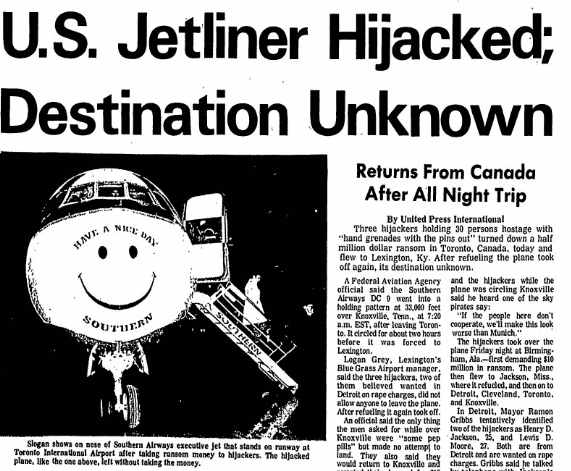
During the subsequent climb, their motive was revealed. Having been unfairly treated in the Michigan city, racially profiled, and arrested for crimes that they claimed that they did not commit, they now sought revenge. Yet to minimize tension in the cabin, they instructed the two flight attendants to serve the catered dinner of salad, steak, and potatoes, which they themselves consumed, along with copious amounts of alcoholic beverages. These apparently calmed them to the point where they were persuaded to permit the passengers to redress. What could now be considered “routine” inside the aircraft, however, did not extend to the conditions outside of it.
Detroit Metropolitan Wayne County Airport (DTW) had closed due to heavy rain and fog, and when the DC-9 reached the area, it was forced to circle. It was during this time that the hijackers stated their demands, reduced to ten and ten—that is, $10 million and ten parachutes.
But two hours of circling resulted in no weather improvement and only depleted fuel, forcing it to divert to nearby Cleveland Hopkins International Airport (CLE), where the ransom money, the parachutes, and stimulants to keep the crew alert could be flown for transfer to the hijacked DC-9.
Landing at 0100, the aircraft was refueled, but was informed that the one carrying the supplies, which would originate in Chicago, would not arrive in CLE for at least two more hours. Beginning to feel betrayed, the hijackers lost all trust when they glimpsed seven figures approaching the DC-9, despite emphatic orders to the contrary, and ordered it to take off immediately.
Already poised on the runway’s threshold with its engines running the entire time, it accelerated, and Captain Haas rotated it, enabling it to climb skyward. It was ordered to set course for Toronto.
A Long Night Over North America
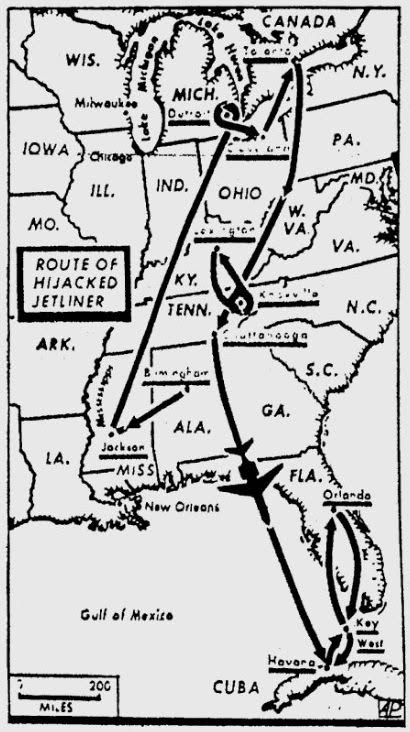
The supply plane had intermittently taken off from Chicago and set its own course for the Canadian destination, where it landed at 04:31. The Southern DC-9 maintained a circular holding pattern until that had occurred and was thus able to land on Runway 5R at Toronto Pearson International Airport (YYZ), parking at its threshold with its engines running.
Control tower personnel, attempting to fatigue the hijackers, delayed the dispatch of the fuel truck, prompting tense, tedious bargaining that soon erupted into impatient fury. They threatened to return to the sky if the truck were not immediately available, but with only 7,300 pounds of fuel on board, they would not have even been able to reach the US border.
At 0537, it finally materialized, but their now mollified temper just as quickly reignited. The fuel truck attendant, instructed to wear nothing but a bathing suit and bring the mounting list of supplies, which now included food, water, coffee, and the stimulants, only carried the money, in the amount of $500,000, transported from Chicago, while the remaining items were not to be found. Perhaps the greatest anger-feeding fact, however, was the discovery that the money had not been provided by the city of Detroit, which the hijackers deemed the rightful rectifier of their injustices. Instead, it had been supplied by Southern Airways itself.
Unsatisfied, they once again ordered the aircraft airborne, which occurred at 0615, and it headed south for what was intended as its longest sector, a southern one to a destination they believed was the only one where they could achieve full satisfaction: Cuba.
Because the aircraft lacked the range to cover such a distance, it briefly landed in Lexington, Kentucky, at 0935, only to take off again 20 minutes later.
When negotiations for the $10 million once again failed, the three hijackers threatened to crash the airplane into the Atomic Energy Commission facilities at Oak Ridge, Tennessee, and it was not until the early afternoon that a Learjet carrying the demanded ransom money touched down at Chattanooga’s Lovell Field (CHA), enabling the Southern DC-9 to follow closely on its heels 35 minutes later. The requested fuel truck, again operated by a lone attendant, approached the aircraft with the long list of provisions that now included buckets of fried chicken, sandwiches, soft drinks, coffee, tea, beer, stimulants, bullet-proof vests, and riot helmets, enabling him to pass them to the first officer through his right cockpit window.
Once refueled, the aircraft retook off and climbed to 21,000 feet, where the hijackers popped the stimulants into the crew members’ mouths. It was later revealed that they were only made of sugar. Yet the elusively delivered ransom money once again proved unsatisfactory, because it was learned that it had once again come from the airline itself. Proving that they sought revenge more than the monetary reward, they freely distributed it to the crew and the passengers. It failed to serve their purpose.
Maintaining a southeasterly course at 33,000 feet, the DC-9 overflew Georgia and Florida and eventually passed out over the Caribbean Sea, reaching Cuban airspace at 1600 local time on 11 November and landing on Runway 5 at Havana’s José Martí International Airport (HAV) 50 minutes later.
Havana, Orlando, and a Desperate Escape
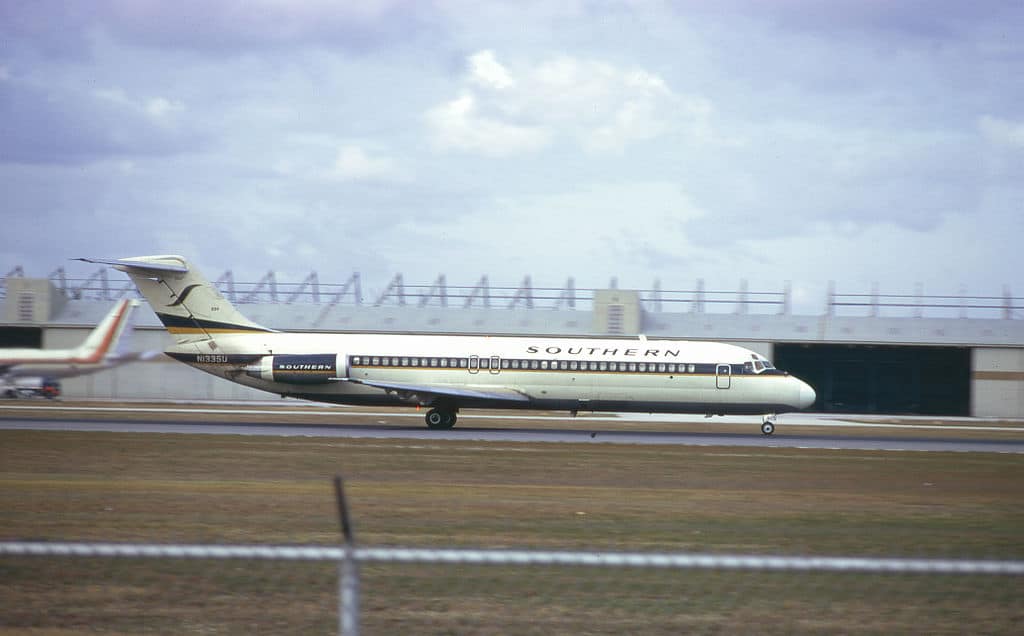
After it had parked, Jackson, who believed he would be granted sanctuary by Fidel Castro, disembarked and spoke to a local official, who claimed that Castro himself was unavailable (though he was actually in the tower, observing the situation the whole time).
Surmising that he would not be given the friendly welcome he had envisioned, he reboarded the aircraft and demanded sufficient fuel for an escape, but it was not quickly provided, and only after the first officer himself had deplaned to supervise the refueling was it able to take off at 1900 — 21 hours into its ordeal.
Making the short hop to Key West, Florida, to top off its tanks at the Boca Chica Naval Air Station, it was once again in the air, the hijackers now announcing its new destination, which they believed would provide the sanctuary that Cuba had not been able to: Switzerland.
The DC-9-10’s range was only about 1,500 miles, while the Atlantic stretched for more than twice that. If it continued on its present course, Captain Haas explained to the hijackers, it would run out of fuel, ditch into the ocean, and all would fall prey to shark pools, even if they survived the actual plunge into the water. He ultimately convinced them to return to Orlando, where they could transfer to a long-range, quad-engine Air Force jet, suitably equipped with overwater navigation, crossing the Atlantic by way of New York, Newfoundland, Ireland, and Great Britain.
The DC-9 landed at Orlando’s McCoy Jetport (MCO) at 2115, a landing that would later prove to be the beginning of the end.
A Final Flight and an Impossible Landing
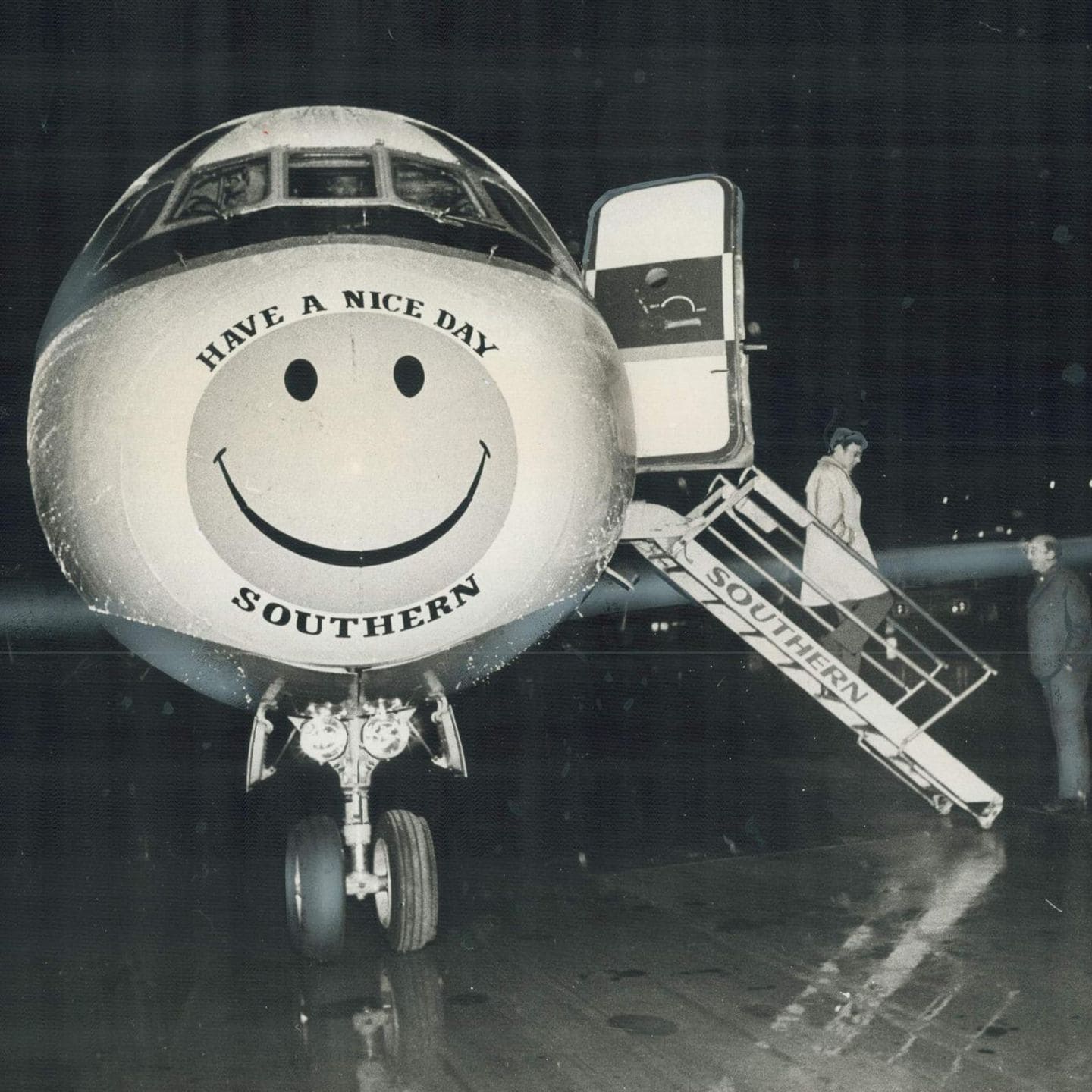
A fuel truck parked at its end, and for the first time since the ordeal had started the previous evening, the hijackers permitted the engines to be turned off to accept their vitally needed fuel, one at a time.
Invisible to the hijackers because of the darkness, however, FBI agents had positioned themselves on parallel Runway 36L, and they began shooting at the DC-9’s tires in order to incapacitate it. The hijackers themselves retaliated, opening the cockpit windows and returning fire.
Now with the firm conviction that they had been betrayed, they ordered First Officer Johnson to stand up and pumped a bullet into his right arm, and then demanded that the captain take off, despite the tire damage and Johnson’s wounded condition.
What they demanded, Haas felt, was impossible, if not suicidal. Nevertheless, virtually assured death by the grenade held only inches from his face, he was left without choice or even reason: he advanced the throttles.
Jolting down the runway at ever-mounting speed and spitting fire-threatening sparks, the twinjet slowly and sluggishly accelerated, its metal rims, like flints, becoming glowingly hot and ejecting rubber shards from the no-longer existent tires that were ingested by the engines. Rotating, during which the nose wheel was elevator-coaxed off the surface, the DC-9 sat on its main wheel rims before, impossibly, taking to the sky, surmounting friction and speed, then disappearing into the darkness, left only briefly visible until its anti-collision lights disappeared.
Survival in Havana and Lasting Consequences
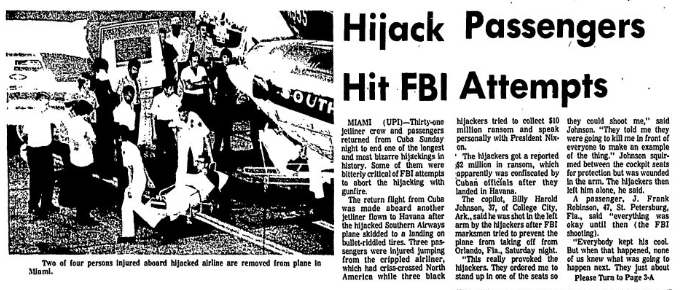
During its climb out, the hijackers plotted their next course of action, considering the reception they had received in both Havana and Orlando and concluding that the former had been decidedly friendlier than the latter. It was therefore to the former that they now elected to go. It would, without question, be the aircraft’s final destination, and many elements indicated that it would not necessarily be safely reached.
No tires remained on the main wheels, leaving only friction—and potentially fire—causing metal-to-surface contact. One of the engines was severely low on oil, and some of its fan blades had been bent by the ingested rubber. The first officer was bleeding, in pain, and only half-conscious. The aircraft could not be pressurized, leaving it to cruise at altitudes no higher than 10,000 feet. The two pilots, malnourished and dehydrated, had not slept for 48 hours and had been pushed to their emotional, physical, and psychological limits, having been under the constant threat of death. And they now faced their second landing in a communist country with an incapacitated airplane.
Aware of Flight 49’s return, Castro ordered that the airport be prepared for its emergency landing and alerted hospitals of the imminent arrival of the wounded. But even foaming the runway would not aid the situation: there was insufficient substance available to do so.
As the flight attendants prepared the passengers for the landing, the hijackers, for the first time, realized the severity of the situation they had created. While they had continually threatened the safety and lives of everyone on board, they were now in the same situation, and their weapons could do nothing to resolve it. They symbolically surrendered them to the two attendants as verification of this fact.
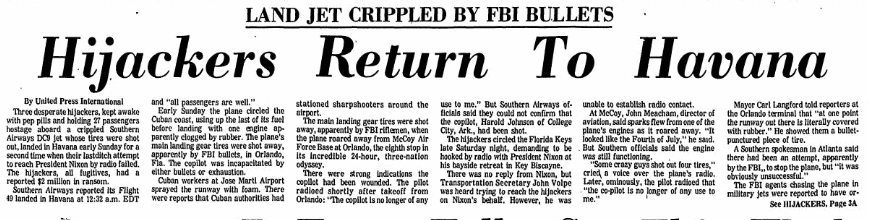
At 2315, the lights of Havana became visible through the cockpit windows. Although flight deck instrumentation indicated that the landing gear had successfully extended, Captain Haas was unsure whether it was in the locked position due to damage sustained during the Orlando shootout and takeoff, prompting him to descend to 300 feet and request visual tower verification. He also lowered a periscopic device in the passenger cabin to further verify their position.
Approaching HAV’s 12,000-foot-long, light-lined Runway 23, the passengers now in their crash positions, the twinjet shed its remaining altitude and passed over its threshold. The engines were throttled back, and the ear-piercing emission from its Pratt and Whitney JT8D turbofans died down.
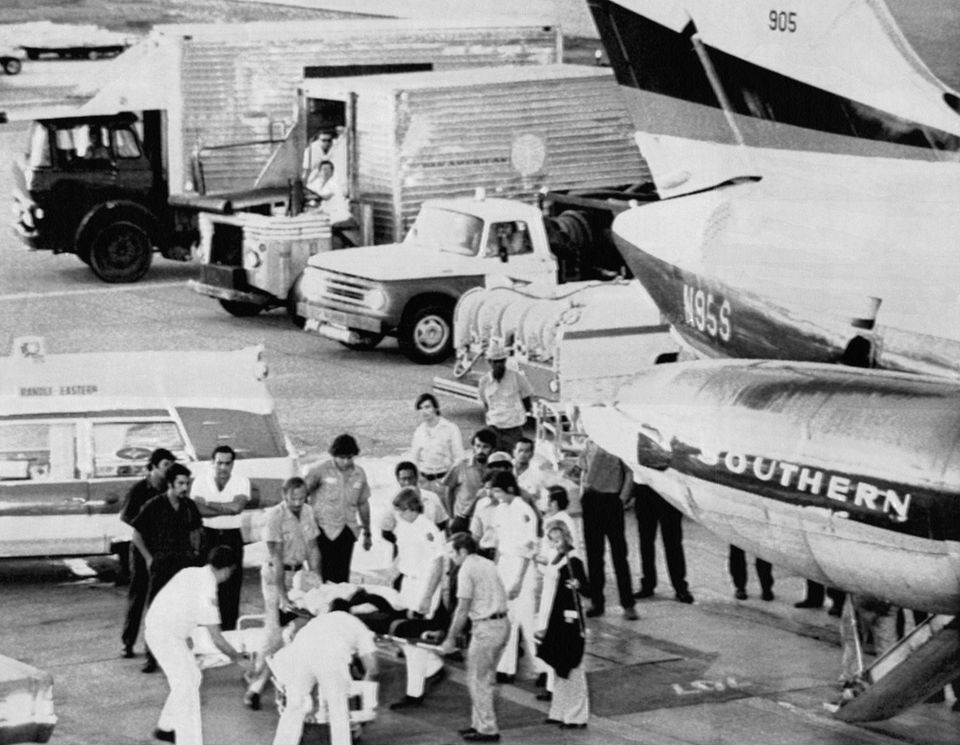
Flaring, the aircraft settled onto the concrete with its main wheel metal rims, from which sparks and smoke erupted upon contact. Violently jolting, it settled and decelerated until the aircraft was drained of its momentum and came to a full stop, enabling the passengers to evacuate through the overwing emergency exits, which had been opened before touchdown, and leave the aircraft for the first time in some 29 hours. The molten metal was doused with fire-retarding foam.
All miraculously survived, despite some injuries. The hijackers were arrested. The captain was met by Fidel Castro, who gave him a bear hug. The first officer was carried off the aircraft in a stretcher, and he, along with the wounded passengers, was taken to the city’s hospital, while the remainder of the passengers and crew members were treated to a dinner in the terminal.
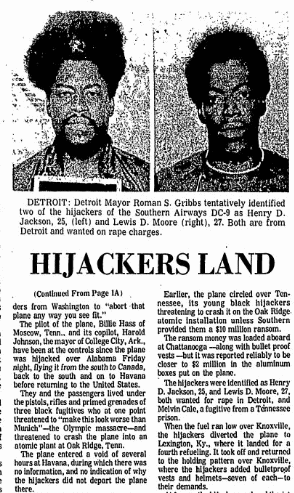
The three hijackers served eight years in a Cuban prison in cells that Castro described as “four-by-four-by-four foot” in dimension, but all were subsequently extradited to the United States. Cale and Moore served an additional 20 years there, while Jackson served another five over that for his shooting of the first officer.
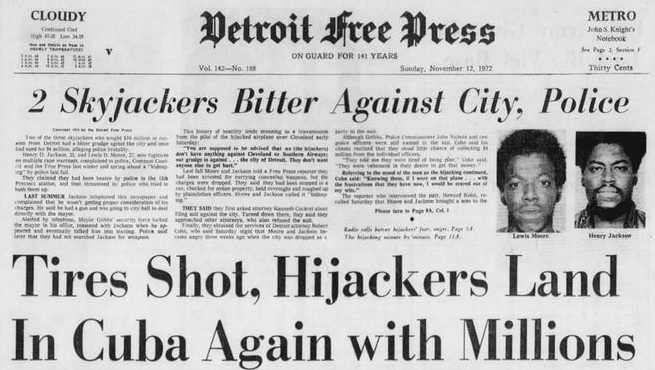
As a result of the 30-hour ordeal, the FAA implemented tighter security measures at 531 domestic airports, resulting in the mandatory screening of all passengers, crew members, and their luggage. Flight crews were also rigidly trained for skyjacking situations. Relations with Cuba temporarily improved, since Castro demonstrated that he would accept no tolerance for such attempts and refused to grant any immunity or freedom to those who sought sanctuary by employing such extreme methods.
Both the crew’s expertise and the DC-9’s design integrity were credited with ensuring the passengers’ ultimate safety and survival. Although the circumstances the Southern Airways one was subjected to exceeded those for which it had been certified, it demonstrated two of its original design goals—namely, ruggedness and reliability. And while the hijackers’ original purpose of alerting the world to the alleged injustices that occurred in the City of Detroit was successful, the way in which they sought to do so—inflict the same treatment on innocent others that they were allegedly subjected to—only resulted in their own loss of freedom.
[ad_2]
Source link